
Post-Its For Writers
Writers spend a lot of time talking to themselves, so it makes sense we write notes to ourselves, too.
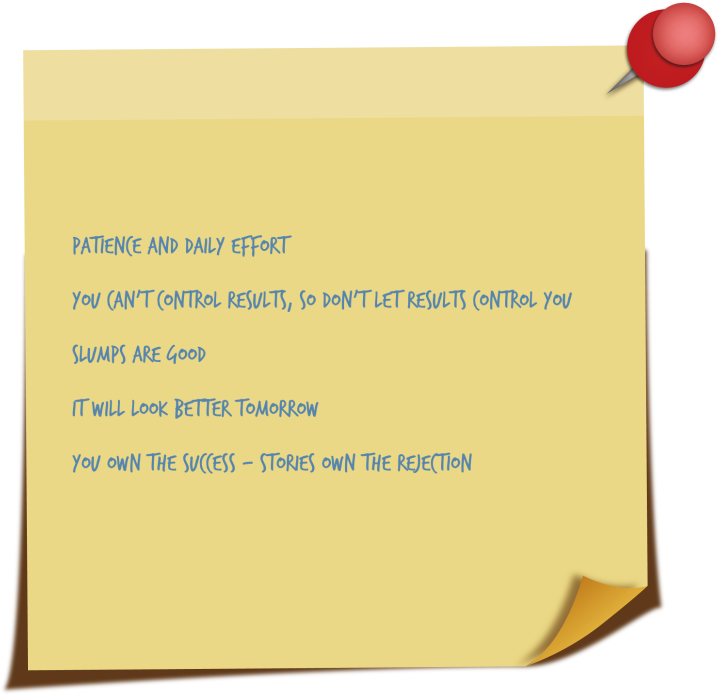
Here are the writerly Post-It notes wreathing my monitor. More than reminders, these are daily affirmations.
PATIENCE AND DAILY EFFORT
This is my guiding star. You have to put in the work, and you have to work (almost) every day. Patience means letting the work unfold at the rate it requires. You can't write tomorrow's words today. You can put in more hours and maybe get more words, but over time you will wear yourself out.
I set daily word goals when I'm working. I aim for 2000+ words for first draft work (working from an outline). I like to get at least 2500 daily words when doing a second draft. Revision, polishing, and editing is harder to measure with word targets, but if I put three hours into an editing session, I'm usually pretty satisfied.
The numbers are less important than doing the work (the daily effort part) or accepting your results (the patience part). Over time it evens out.
YOU CAN'T CONTROL RESULTS, SO DON'T LET RESULTS CONTROL YOU
My work as a writer consists of:
Writing as well as I can, and trying to get better at the job.
Developing business opportunities and markets for my work.
Submitting work and promoting published writing.
That's it.
These things are not my work:
Making editors accept my work.
Making critics notice my work.
Making readers like my work.
Aside from a continuing obligation to promote and celebrate the work, my job is done when I turn in a story. I can't make anyone like it -- they will or they won't, depending in part on how good a job I've done, but also on their own tastes, mood, and attitude on any given day.
I can't control results. I can influence them, through good work and dogged business development -- but I can't control them.
I. Can't. Control. Them.
Because of this, I try to forget about past or pending work and devote myself entirely to new projects. Once an arrow is in flight, there's nothing I can do. It may hit the target. It might not.
I can't control it. I try to not let it control me.
SLUMPS ARE GOOD
Since I'm a full-time writer, I'm going to experience slumps. Some days are better than others, and the bad days can clump together. I suppose you could call this writer's block, but I prefer the baseball metaphor of a slump. A slumping ballplayer might have no luck at the plate, but they still show up to the ballpark, get in their work, prepare for the game. They collect some hits or they don't, then they come back to the yard and do it again until they bust that slump (or they get benched or cut, but we won't talk about that).
I'd prefer to never have a slump, but that's impossible. The reason slumps are good is because they parse your failure in terms of duration. They are finite things, and not a permanent state. If you stay at the job long enough, you will experience slumps. You will also break slumps. Over time you will will recognize your slumps don't last forever. You can look forward to breaking them!
Don't sweat them too much. Put in the work. It will get better.
IT WILL LOOK BETTER TOMORROW
Maybe it gets better as soon as tomorrow!
I frequently experience frustration and even disgust with work as I do it, particularly in early drafts. When I get to my word quota I will more often than not be convinced it is all garbage and a disgrace to the language. That's the time to turn off the computer and trust that when you come back in the morning or on Monday it won't be as bad as you thought.
Sometimes it is worse, but in my experience, this is rarely the case. Imperfect work will remain imperfect, but sleeping on it for a night or two helps me recognize the parts that are working -- the story I was trying to tell in that first draft. When I go back to an old draft it is always with trepidation, but when I get to the end ... it's usually not that bad. I know what to do. I can make it work.
Tomorow! Not tonight! Sleep on it. It will look better tomorrow, in almost every case.
YOU OWN THE SUCCESS — STORIES OWN THE REJECTION
When a story is complete and submitted, I think of it as its own thing. If it has a hard time finding a market, that struggle belongs to the story, not to me. If the story never gets published, it was the story that failed -- not me!
Conversely, I hog all the glory. If a story is published, if a reader likes it, if it gets an award -- that was all me, baby. That's me up there, spraying the champagne. But I refuse to feel equivalent lows when a story is having trouble. I'll keep putting it in the market, maybe revising it from time to time. You never give up on a lost cat!
But if the story fails, it fails. The failure belongs to the story. I was patient. I can't control this stuff. I put in daily effort and will do better tomorrow! When the slump is busted!