
Confessions of an Edgars Judge
With Edgars nominations revealed this week, I can drop my silence about how I spent my reading time in 2025 -- serving as a judge in the Paperback Original category for the Edgars. I won't discuss privileged details of methodologies or deliberations, but I will reflect on what I learned from the process, and along the way I'll offer best practices for publishers and writers to improve their chances of taking home an ugly little Edgar Allen Poe statue.
I'm a relatively new member of the Mystery Writers of America. I volunteered to be an Edgars judge because I had the time and the interest, and because I wanted to more deeply engage with the MWA and its members. I had an "oh, crap" moment when my application was accepted, but I kept my schedule clear and settled in to read some books.
Then waited.
And waited some more.
In February, I received my first book. That was the only book for the month. In March, I received six.
Here's the most important thing publishers can do to boost their Edgars chances -- get books to the judges, and get them to judges early. Many books don't come out until the fall, and there's not much you can do about that, but saving all or most of your releases for one or two bulk mailings per year does your authors no favors. Early in the season is when judges have the most enthusiasm and time for your books. Take advantage of it!
Because I am a fiend for data, here's a graph of the number of books I received per month:
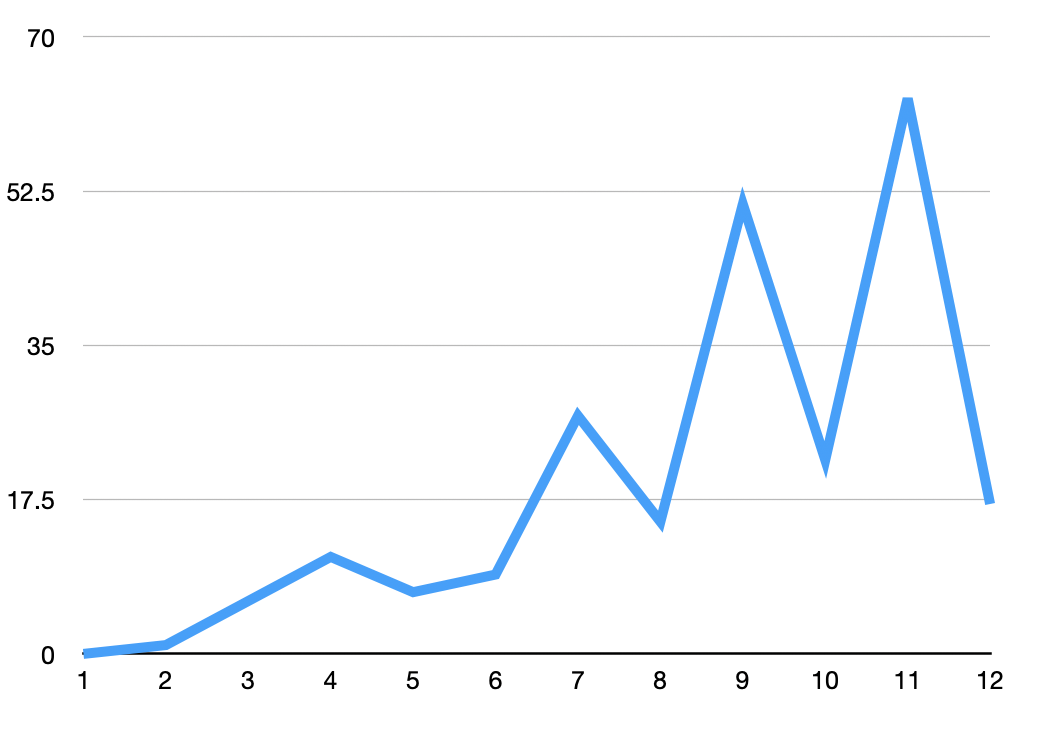
months on the bottom, 0-12
Less than 15% of our books were received in the first six months of the year. Almost 60% came in just the months of September, October, and November. That's a logjam in what is already a busy time of the year. Publishers should do everything in their power to get their books to judges before the fall. Even a few weeks makes a difference.
What can authors do about this? Not a lot, to be honest, as there must be no contact between authors and judges -- but authors should stay in touch with their publishers, and follow-up to see if they have sent out their books. Merely seeing your title listed on the MWA Submissions pages is not enough. There can be a substantial gap between a book being listed and a book getting to judges. Press your publisher for results. Get the receipts.
However and whenever we received them, by the end of the year we were talking about a pile of books:
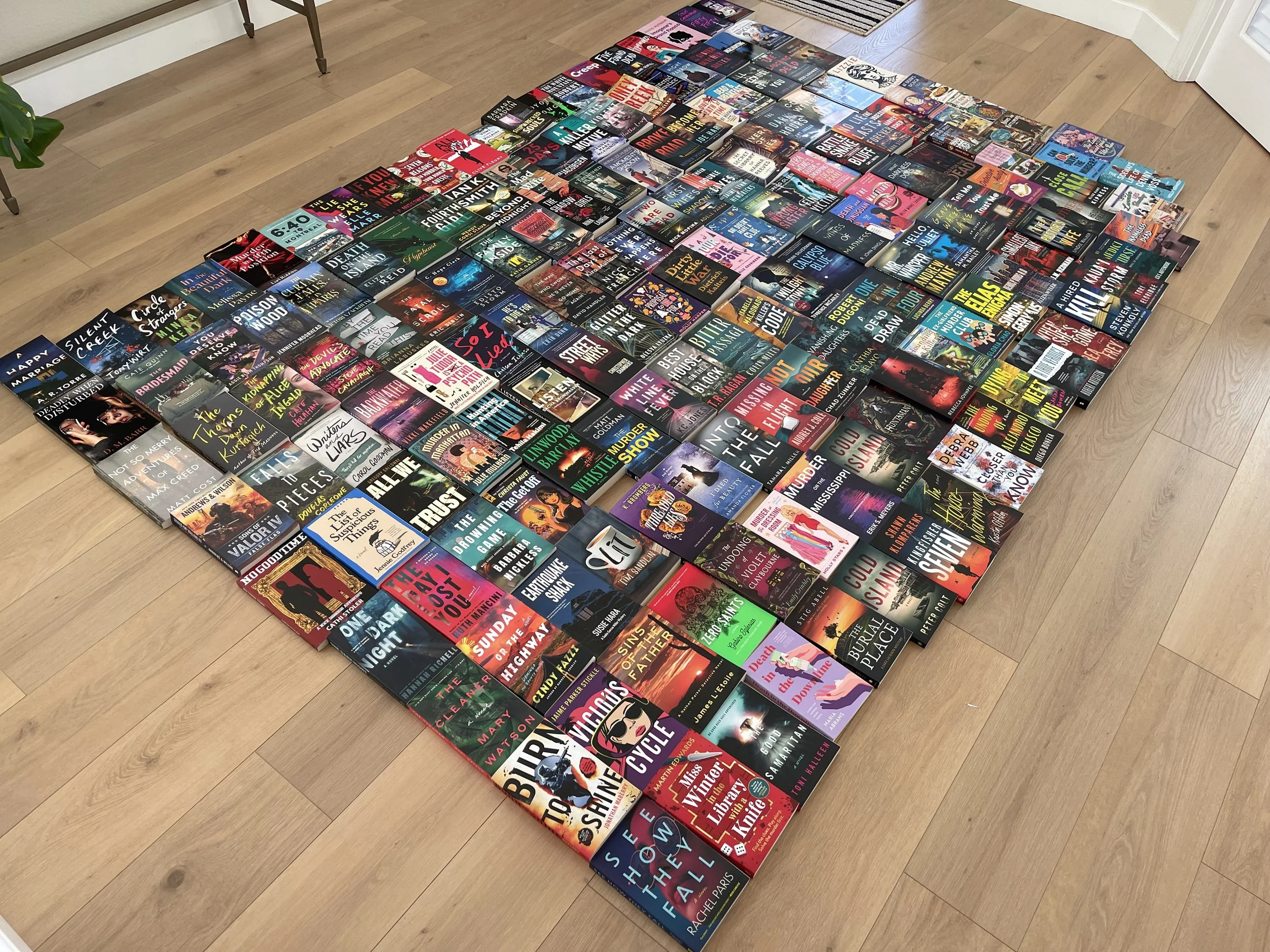
That's about 229 books by my count, not including a couple dozen eBooks ... which deserves a comment. eBooks are great, and some judges prefer them (especially if that means getting a book early), but I preferred physical copies. This surprised me, as I don't have a lot of space, and I don't keep things for their own sakes, but I found physical books easier to track and organize while doing my judging. I ran everything off a spreadsheet, so no book suffered for attention if it wasn't a print copy, but print copies were easier for this judge to sort into piles -- to be read, to be considered, to be reconsidered ... So there's another best practice for publishers. Sending eBooks is fine, especially if that gets them to judges early, but paper copies have value too. Send both, if you can.
How does a panel of judges read 229 books? Just like everyone else -- one at a time. Once the books started rolling in I was reading entries every night, for several hours. Books in the morning. Books at lunch. I'm not an especially fast reader, though one of the benefits of this exercise was building up my reading muscles. By the time we put our pencils down in January I'd settled into a marathon pace and had a hard time without having a book that needed reading. To run cooldown laps I volunteered to read short stories for the Derringer Awards. After that, my eyes will be my own again. I'm not sure what I'll do with myself.
What do judges look for in an Edgars winner or nominee? Every judge is different, and I can speak only for myself. I was primarily looking for books that entertained, but I was also alert for books exhibiting superior craft or trying new things. Crime/mystery is a formulaic genre -- and that's great, because I love formula -- but tropes being too forward was something that shifted reading from a joy to an obligation. Likewise, many books are written to the market, which is fine, but books written from the heart most captivated my attention. The best books do both those things.
What moved a book to my "no" pile? A lot of things. I went into every book hoping it would be great, and I approached them with a generous heart. As a writer I know that books are our children. I tried to treat each book as I'd hope another writer would treat my kids. Every book is worthy.
Not every book is award-worthy.
For most books, being published is the award, and it's a massive one. The book has been written, selected, edited, released to readers. It exists in the world, for a season or forever. I hope authors take a moment to celebrate the deep and improbable importance of publishing a book. They've already won at everything that matters.
To be award-worthy, a book has to make it through my personal steeplechase of disqualifying obstacles. Every rider and horse breaks from the gate with an eye on the finish line, but before long the carnage piles up. Indifferent writing -- I expect you to write better than I do. Poor plotting -- you can make it up as you go along, but if I can tell that's what you're doing, you’ve got a problem. Shallow characters defined only by their possessions, professions, and lusts. Series novels that do not sufficiently onboard a new reader. Meaningless stakes. Repetitive narrative. Books auditioning for Netflix deals as much or more as they're trying to be books. Sagging in the middle after a fast start. Unearned endings. Worse -- endings that protect the status quo, because selling the next book is more important than getting to the truth of this one.
Get through that gauntlet, entertain me along the way, have something to say, and make me feel something ... that gets you into the consideration stack. Then comes the process of discussion and voting that I will not discuss, and which results in the final slate. Larry David said a good deal is one where every party is at least a little unhappy, and I think the same can be said of awards slates.
Congratulations to the nominees. It takes more than luck to win this kind of race.
After a year of my life to read I don't know how many million words, I can say I'm glad I did this, but I'm not sure I'd do it again. The time commitment is extreme and I felt a considerable weight of responsibility. I learned some things -- discovered new writers, perceived for the first time differences between various publishing houses, developed an appreciation for subgenres I might not usually explore. I also saw how throughly out-of-step my own writing is with the current market, which I'm choosing to view as a virtue, otherwise I'll cry.
Thank you to the many publishers who sent me books last year, whether they did it early or late, and to all the authors who poured themselves into these books. In the months ahead, I'll offer my personal capsule reviews of a few of these novels over on my Instagram feed.
Thanks for reading! Comments are welcome. Happy to answer questions within the bounds of required confidentiality.
